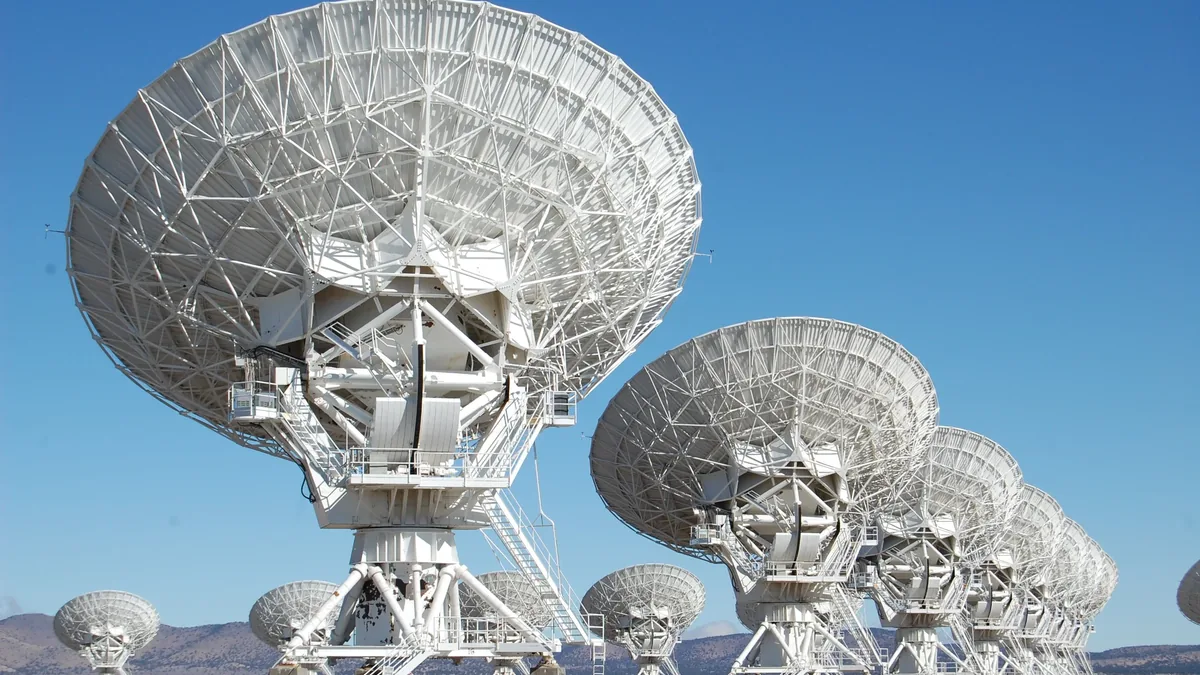
Estrack And Deep Space Antennas
| Country of origin | International (ESA member states) |
|---|---|
| First created | 1970s (first antenna commissioned) |
| Original use | Tracking and communicating with spacecraft |
| Operator | European Space Agency (ESA) |
| Network type | Ground station network |
| Primary function | Telemetry, tracking, and command (TT&C) |
| Key locations | Australia, Spain, Argentina |
| Antenna diameter range | 15 meters to 35 meters |
Origin and history
The European Space Agency's Estrack network originated in Europe during the 1970s. Its initial development was driven by the need for independent spacecraft tracking and data acquisition for ESA's early missions. The first ground station was established in Villafranca del Castillo, Spain, in the late 1970s. The network's creation was a strategic decision to ensure European autonomy in space communications. The deep space antenna component of the network was a later development, emerging as ESA's mission profile expanded beyond Earth orbit. The system's history is one of progressive expansion and technological upgrade to meet evolving mission requirements.
What it is designed for
Estrack and its Deep Space Antennas are designed for telemetry, tracking, and command (TT&C) of spacecraft. The primary function is to maintain two-way communication with scientific missions operating far from Earth. This includes receiving scientific data from probes at immense distances, such as at Mars, Venus, or the outer planets. The system is engineered to send precise navigation commands to adjust a spacecraft's trajectory. It also provides radiometric data used to precisely determine a spacecraft's position and velocity. Furthermore, the network supports critical mission phases like launch, orbit insertion, and landings by ensuring continuous communication coverage.
Development and versions
The network has developed from a few stations supporting near-Earth missions to a global system with deep space capability. Early versions included 15-meter antennas located within Europe, such as in Redu, Belgium, and Villafranca, Spain. A major development was the inauguration of the first 35-meter deep space antenna in New Norcia, Australia, in the early 2000s. This was followed by a second 35-meter antenna in Cebreros, Spain, later in the same decade. The third 35-meter deep space antenna, located in Malargüe, Argentina, was completed in the 2010s, completing the deep space triad. Ongoing development includes technology upgrades like beam waveguide systems and higher frequency bands (Ka-band) to increase data return rates.
Overview
The Estrack network is a globally distributed system of ground stations operated by the European Space Agency. It comprises multiple sites across several continents, including Europe, South America, and Australia. The core deep space capability is provided by three identical 35-meter diameter parabolic antennas strategically spaced in longitude for continuous sky coverage. These stations are supplemented by smaller antennas for near-Earth missions and specialized facilities for specific tasks like launch support. The network operates using a mix of radio frequency bands, including S-band, X-band, and Ka-band. Centralized control and scheduling of the entire network is managed from the European Space Operations Centre (ESOC) in Darmstadt, Germany.
What to know
The network is a critical infrastructure, not a single launch vehicle or spacecraft, but the ground-based system that enables them to function. Its performance is measured in terms of sensitivity, pointing accuracy, and available communication time, not thrust or payload capacity. The antennas must contend with significant signal attenuation and time delays when communicating across interplanetary distances. Coordination with other space agency networks, like NASA's Deep Space Network, is common for international missions to maximize coverage. The system requires extremely precise frequency and timing references, often using atomic clocks, to maintain coherent links. Maintenance and upgrade cycles are constant to incorporate new technologies and mitigate the effects of aging hardware on reliability.
Common questions
A common question is why ESA built its own deep space network instead of relying on NASA's. The answer relates to strategic independence, guaranteed access time for European missions, and the ability to control scheduling priorities. People often ask how the antennas locate a tiny spacecraft in the vastness of space, which involves precise orbital predictions and radio signal acquisition sequences. Another frequent inquiry concerns the data rates possible from deep space, which are limited by distance and power, often ranging from a few bits per second to several hundred kilobits per second. Questions about how the antennas withstand environmental conditions like wind and rain are addressed by referencing their design limits and protective stow positions. Many wonder what happens if an antenna fails, a scenario mitigated by network redundancy and cross-support agreements with other agencies. The use of the network for non-ESA missions, such as commercial or other national agency projects, is also a regular topic of inquiry.
Pros and cons
A major pro is the provision of autonomous, reliable communication access for European and partner deep space missions, ensuring control over critical operations. The global distribution of the three deep space antennas provides excellent sky coverage and mission flexibility. A significant con is the immense operational cost and complexity of maintaining such a network of highly specialized, precision facilities spread across the globe. The highly specialized nature of the technology also creates a dependency on a limited pool of expert engineers and technicians for maintenance and troubleshooting. A common mistake in public perception is underestimating the constant need for software updates and hardware refurbishment to combat obsolescence, which strains long-term budgets. Entities might regret the investment if their mission portfolio does not require deep space access, as the cost-benefit ratio would be unfavorable compared to simpler commercial communication services.
Who it suits
This infrastructure suits the European Space Agency and its member states undertaking scientific missions beyond Earth orbit, such as planetary explorers and space telescopes. It is essential for any mission requiring high-gain, sensitive communication links over astronomical distances where commercial satellite networks are useless. The network also suits international partner agencies needing reliable cross-support for their missions, providing a vital redundancy to other global networks. It is well-suited for missions with high-data-volume scientific returns, like imaging spectrometers or radar instruments, which require the high bandwidth of the Ka-band links. It does not suit small, commercial low-Earth orbit satellite operators, for whom dedicated ground stations or commercial network services are far more cost-effective. The system is fundamentally designed for government-funded science and exploration, not for routine commercial telecommunications.
Latest Estrack And Deep Space Antennas news
Latest reporting

Stoke Space Secures $1 Billion Series E Funding
Stoke Space has raised an initial $1 billion in a Series E funding round, bringing total capital raised to $2.3 billion.
ESA Hosts FLEX and Sentinel-3C Launch Re-Watch Event
The European Space Agency will host a media event on September 15, 2026, to re-watch the Vega-C launch of the FLEX and Sentinel-3C Earth observation
ESA Reviews Rocket Capacity as Amazon Orders Pressure Launch
The European Space Agency is assessing if its current rocket fleet can handle a satellite launch demand surge expected to peak around 2030, driven by...

European Space CEOs Call for Overhaul of Fragmented Sector
A report from trade group ASD Eurospace, based on anonymous interviews with 15 industry CEOs, reveals deep dissatisfaction with Europe's fragmented...
Sierra Space Books Dream Chaser First Flight Payloads
Sierra Space has secured undisclosed national security and commercial customers to fly payloads on the inaugural mission of its Dream Chaser...
China’s Rocket Startups Tie Orbital Flights to IPO Plans
Chinese commercial space firms must achieve orbital insertion with reusable medium-to-large launch vehicles to qualify for STAR Market listings...