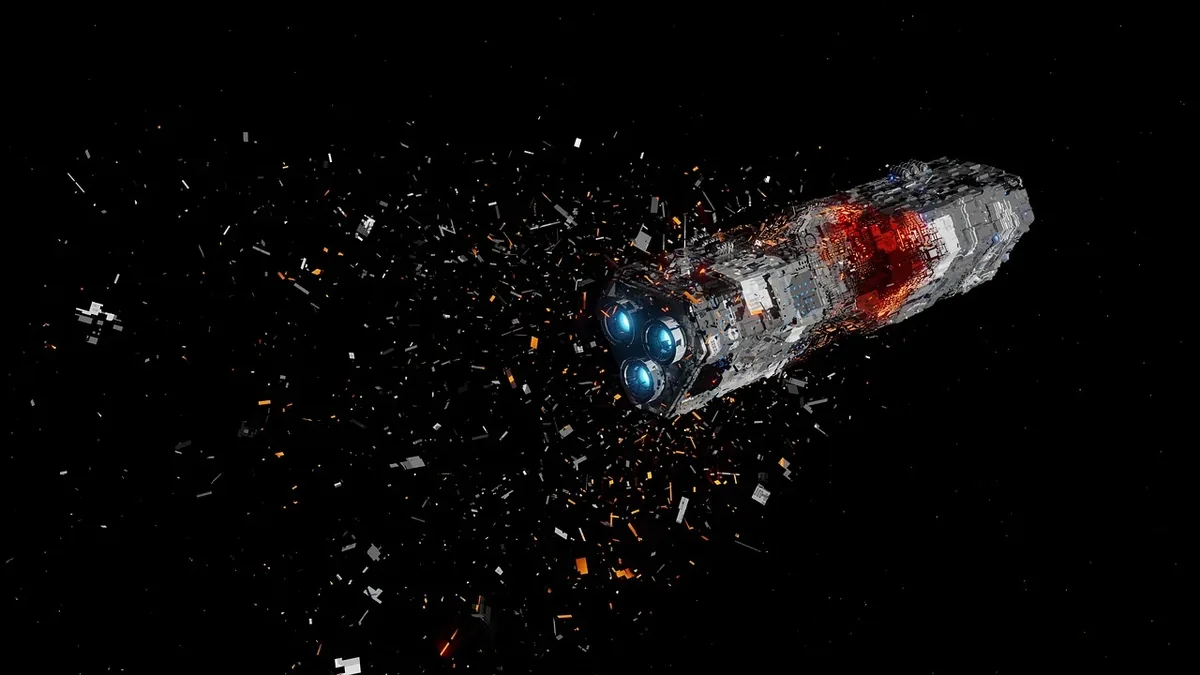
Orbital Debris And Collision Avoidance
| Launch vehicle | Varies by mission |
|---|---|
| Payload type | Varies by mission (e.g., satellite, cargo, crew) |
| Launch window | Time interval for a viable launch |
| Orbital regime | Varies by mission (e.g., LEO, GEO, transfer) |
| Collision risk assessment | Standard procedure for all missions |
| Debris mitigation compliance | Adherence to international guidelines |
| Post-mission disposal plan | Required for most modern missions |
Origin and history
The concept of orbital debris and the need for collision avoidance emerged as a direct consequence of space activity, originating with the spacefaring nations in the mid-20th century. The first documented collision between two cataloged objects occurred in the 1990s, but the foundational debris population stems from fragmentation events dating back to the 1960s. The intentional destruction of the Fengyun-1C satellite by China in 2007 represented a pivotal event, dramatically increasing the trackable debris population and highlighting the escalation risk. The United States, through its Space Surveillance Network, began tracking objects in the late 1950s, which formed the initial technical basis for catalog maintenance. International recognition of the problem coalesced in the 1990s with the publication of mitigation guidelines by organizations like the Inter-Agency Space Debris Coordination Committee. The field evolved from passive tracking to active conjunction assessment and collision avoidance maneuvers as satellite populations, particularly commercial constellations, expanded rapidly in the 21st century.
What it is for
Orbital debris and collision avoidance procedures exist to protect functional spacecraft from catastrophic collisions with other objects in Earth orbit. Their primary purpose is to ensure the long-term sustainability of the space environment by preventing the uncontrolled growth of debris through collisions. These practices are for preserving the operational lifetime and multi-million-dollar investments in satellites, space stations, and other orbital assets. They are for safeguarding human life during crewed missions aboard vehicles like the International Space Station, where a penetration could be fatal. The discipline is also for enabling safe access to space by managing traffic in increasingly congested orbital regimes, particularly low Earth orbit. Furthermore, these protocols are for providing satellite operators with actionable data and standardized processes to make informed decisions about maneuver planning.
Overview
Orbital debris encompasses all human-made objects in Earth orbit that no longer serve a useful function, including defunct satellites, spent rocket bodies, and fragmentation remnants from explosions or collisions. Collision avoidance is the operational process of assessing collision risk between these objects and active spacecraft, often leading to a maneuver to increase separation. The process relies on a continuously updated catalog of tracked objects, maintained by entities like the U.S. Space Force's 18th Space Defense Squadron, which provides orbital data known as Two-Line Elements. Operators use this data in conjunction with their own precise knowledge of their spacecraft's position to screen for close approaches, called conjunctions. When a conjunction with a high probability of collision is identified, analysts assess the risk and may recommend a collision avoidance maneuver, which consumes precious propellant and may disrupt mission operations. The entire framework operates as a critical, daily part of satellite operations for an increasing number of government and commercial entities worldwide.
What to know
It is essential to know that orbital debris is a persistent and growing environmental issue, with over 35,000 objects larger than 10 cm currently tracked and millions more smaller pieces that cannot be tracked but can still cause catastrophic damage. You should know that collision avoidance is not automated; it requires human analysis and decision-making, often under time pressure, balancing collision risk against maneuver costs and mission interruption. A key point is that the standard metric for risk assessment is the probability of collision, combined with the relative miss distance, with thresholds for action varying by operator and asset value. It is important to understand that performing a collision avoidance maneuver has direct consequences, including propellant expenditure, temporary service interruption, and a potential shift in the spacecraft's operational orbit. You must know that there is no single global authority; coordination between satellite operators, especially commercial constellation managers, is voluntary but increasingly necessary. Furthermore, the Kessler Syndrome is a theoretical cascading collision scenario where the density of objects becomes high enough that collisions create new debris, which then causes further collisions, potentially rendering certain orbital regions unusable.
Common questions
A common question is whether small particles of paint or metal can really damage a spacecraft, and the answer is yes, due to the extreme velocities involved, which can exceed 15,000 meters per second on impact. People often ask who is responsible for cleaning up the debris, and while there is no operational large-scale removal service, several technologies are in development, and international guidelines now emphasize post-mission disposal. A frequent inquiry concerns how often collision avoidance maneuvers are performed; for the International Space Station, maneuvers occur several times a year, while large satellite constellations may conduct hundreds of maneuvers annually across their fleets. Many wonder if lasers can be used to push debris away, and while this is a researched concept for small debris, no operational system exists due to significant technical, cost, and policy challenges. Operators commonly question the accuracy of conjunction data, which depends on the quality and timeliness of tracking data for both objects, with uncertainties represented as a growing positional "covariance ellipsoid." A final typical question is what happens if two operators simultaneously maneuver their satellites, potentially making the situation worse, which highlights the need for improved coordination and information sharing channels.
Pros and cons
A major pro of established collision avoidance protocols is that they have successfully prevented numerous catastrophic in-orbit collisions, preserving critical space infrastructure and extending satellite lifespans. The development of automated screening services and data-sharing consortia has improved situational awareness and reduced the burden on individual operators. A significant con is that the process is inherently reactive, addressing symptoms rather than the root cause of the debris population growth, and each avoidance maneuver has a tangible operational cost. A common mistake is for operators to rely solely on public Two-Line Element data without refining it with their own tracking, leading to inaccurate risk assessments or unnecessary maneuvers. Many operators regret the substantial propellant budget that must be reserved for collision avoidance, which directly shortens the revenue-generating mission lifetime of their spacecraft. The system can also create a "tragedy of the commons" scenario, where operators prioritizing individual avoidance may collectively increase congestion or risk in other orbital slots.
Who it suits
Collision avoidance practice is mandatory for any operator of a crewed spacecraft, such as the International Space Station or Chinese Tiangong station, where human life is at direct risk. It is critically suited for operators of high-value national security or scientific assets, where the loss of the spacecraft would be politically or strategically unacceptable. Large commercial constellation operators, such as those managing hundreds or thousands of satellites in low Earth orbit, must implement robust, scalable collision avoidance systems as a core business function. The discipline suits satellite operators in congested orbital regimes like sun-synchronous orbit or the geostationary ring, where the density of objects is highest and conjunction alerts are frequent. It is less immediately critical, but still important, for operators of very small satellites in very low orbits with short natural orbital lifetimes, though their ability to maneuver is often limited. Ultimately, as the orbital environment evolves, proficiency in collision avoidance is becoming a non-negotiable requirement for all responsible space actors, regardless of mission type.
Latest Orbital Debris And Collision Avoidance news
Latest reporting
Isar Aerospace's Spectrum Rocket Reaches Orbit on First
Isar Aerospace successfully launched its Spectrum rocket from Norway, deploying five CubeSats. This marks the first privately funded European orbital...
China’s Rocket Startups Tie Orbital Flights to IPO Plans
Chinese commercial space firms must achieve orbital insertion with reusable medium-to-large launch vehicles to qualify for STAR Market listings...

D-Orbit Orders GomSpace Power Systems for ION Missions
D-Orbit has ordered power systems from GomSpace for its ION orbital transfer vehicle missions in 2026-2027. The contract is worth 6.3 million Danish...
Astroscale Picks Isar for 2027 Debris Removal
Astroscale Japan has selected Isar Aerospace's Spectrum rocket to launch its ADRAS-J2 mission in FY2027. The mission aims to capture and deorbit a...
MaiaSpace Validates Maia Rocket Upper Stage
MaiaSpace has completed a key test for its Maia rocket's upper stage, keeping the vehicle on track for its planned orbital debut in 2027.

Simera Sense Supplies Loft Orbital, Launches
Simera Sense has contracted to supply 10 HyperScape100 hyperspectral imagers to Loft Orbital and has launched a new dual-use version of its xScape200