Engines And Propulsion
| Engine type | Rocket engine |
|---|---|
| Propellant type | Liquid or solid |
| Thrust class | Medium to heavy lift |
| First launch | 20th or 21st century |
| Country of origin | United States, Russia, China, or European consortium |
| Original use | Launch vehicle first stage, upper stage, or orbital insertion |
| Specific impulse | Varies by propellant and engine cycle |
| Thrust-to-weight ratio | Varies by engine type and era |
Origin and history
The modern principles of rocketry and jet propulsion originated from independent developments in multiple regions during the 20th century. The foundational theories for liquid-fueled rocket engines were first documented by American physicist Robert H. Goddard in the 1920s, following his successful static test in 1926. In parallel, key theoretical work on jet propulsion was conducted in Germany and the United Kingdom during the 1930s, leading to the first operational jet aircraft in the early 1940s. The technological demands of the Second World War and the subsequent Cold War space race between the United States and the Soviet Union drove rapid, state-funded advancements in propulsion power and reliability. The development of large-scale liquid and solid rocket engines for intercontinental ballistic missiles directly enabled the launch vehicles used for early satellite and human spaceflight. This era established the core engineering disciplines and industrial base for the propulsion systems used in all contemporary launch vehicles.
What it is for
Engines and propulsion systems are the fundamental components that provide the thrust necessary to overcome Earth's gravity and achieve controlled flight through the atmosphere and space. Their primary function within the context of a launch is to accelerate the vehicle and its payload to a precise orbital velocity, which is approximately 28,000 kilometers per hour for low Earth orbit. Different propulsion stages are sequentially employed to perform specific tasks, such as initial lift-off, ascent through the atmosphere, and final orbital insertion or trajectory correction. Propulsion is also critical for performing controlled maneuvers once in space, including orbital adjustments, rendezvous operations, and de-orbiting for re-entry. For missions beyond Earth orbit, propulsion systems provide the acceleration for trans-lunar or interplanetary trajectories and subsequent braking at the destination. The performance and reliability of these systems directly determine the mass of the payload that can be delivered to a given orbit and the overall success of the launch mission.
Overview
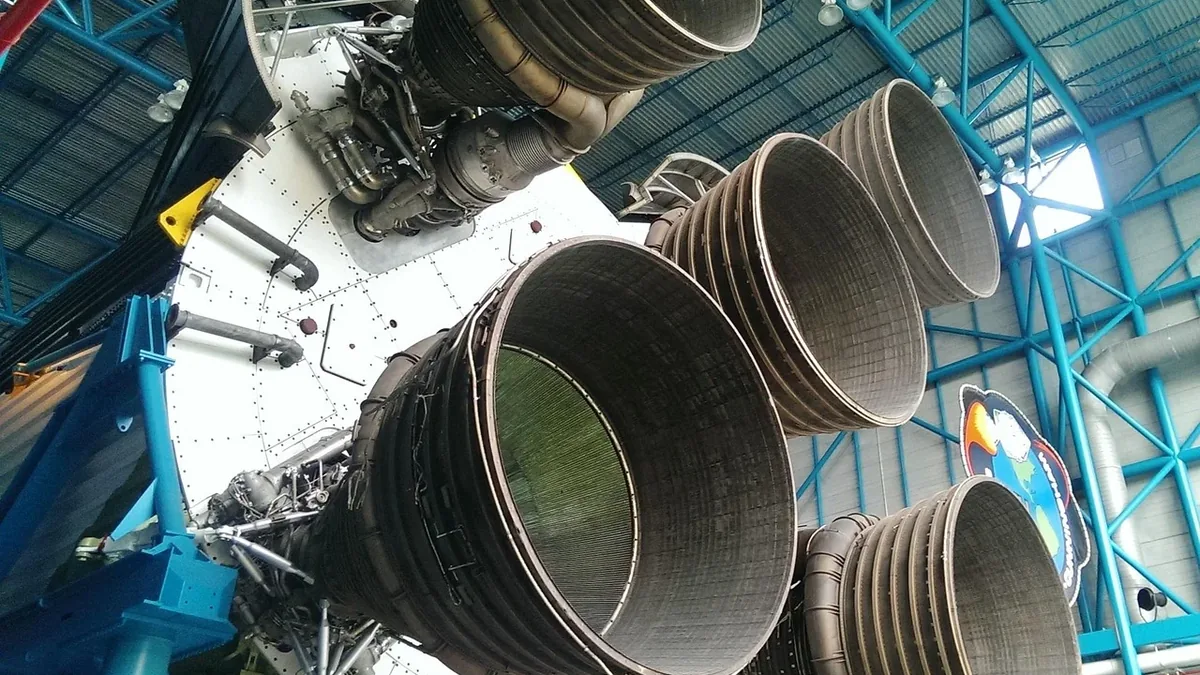
A launch vehicle's propulsion system is typically a complex, multi-stage assembly of engines, fuel and oxidizer tanks, turbopumps, and intricate plumbing. Chemical propulsion, which relies on the exothermic reaction of propellants, remains the dominant technology for launch due to its ability to produce the high thrust required for lift-off. The two main categories are liquid-propellant engines, which use separately stored fuel and oxidizer like kerosene and liquid oxygen, and solid-propellant motors, which contain a pre-mixed, solid propellant grain. Liquid engines offer throttling and restart capability, while solid motors provide simple, high-thrust reliability. Upper stages often use high-efficiency, lower-thrust engines optimized for vacuum conditions to precisely deliver the payload. The entire propulsion architecture is governed by the Tsiolkovsky rocket equation, which links the vehicle's mass ratio, engine efficiency (specific impulse), and the required change in velocity (delta-v).
What to know
The performance of a rocket engine is primarily measured by its thrust, the force it produces, and its specific impulse (Isp), an efficiency metric analogous to miles-per-gallon for propellant. Thrust-to-weight ratio is a critical design parameter for first-stage engines, as the engine must produce thrust significantly greater than the vehicle's initial weight to achieve lift-off. Propellant choice creates major trade-offs; for example, cryogenic propellants like liquid hydrogen offer high Isp but have low density and require complex thermal management. Staging is a fundamental concept where empty propellant tanks and spent engines are jettisoned during flight to reduce mass, allowing subsequent stages to accelerate the remaining structure more effectively. Ignition sequences, especially for large liquid engines, are complex critical events involving precise timing of propellant flow, ignition sources, and thrust ramp-up to avoid catastrophic combustion instability. Post-launch, the trajectory and final orbit are entirely determined by the magnitude and direction of the thrust vectors applied by the propulsion system during its operational burns.
Common questions
What is the difference between a rocket engine and a jet engine? Rocket engines carry both fuel and oxidizer onboard and can operate in the vacuum of space, while jet engines ingest atmospheric oxygen for combustion and are only usable within an atmosphere. Why do rockets often have multiple stages instead of one large engine? Staging allows the vehicle to shed the dead weight of empty tanks and large engines, making the remaining propulsion more efficient at achieving high orbital velocity, as dictated by the rocket equation. What happens to the engines after they separate? First-stage engines are typically either discarded to burn up in the atmosphere or, increasingly, recovered for refurbishment and reuse via controlled powered or unpowered descent. How is thrust directed for steering? Most modern launch vehicles use gimbaling, where the entire main engine nozzle is pivoted hydraulically, or employ separate vernier thrusters or reaction control systems for finer attitude control. What are the main failure points in a propulsion system? Common issues include turbopump failures, combustion instability leading to violent oscillations, propellant valve malfunctions, and thermal erosion or cracking of engine nozzles and combustion chambers. Is electric or nuclear propulsion used for launch? No, these technologies currently produce far too little thrust to overcome Earth's gravity and are reserved for in-space propulsion where efficiency over long durations is paramount.
Pros and cons
The primary advantage of chemical rocket propulsion is its ability to generate immense thrust, making it the only currently viable technology for achieving Earth orbit and beyond. Liquid engines provide precise control over thrust magnitude and direction, enabling complex mission profiles and reusable landing maneuvers. The major, inherent drawback is the colossal propellant mass required; a typical launch vehicle is often over 90% propellant by mass at lift-off, severely limiting payload fraction. This results in extremely high costs per kilogram to orbit, a fundamental constraint on space access. Liquid propulsion systems are mechanically complex, involving thousands of precision parts operating under extreme thermal and pressure stresses, which leads to high manufacturing costs and persistent reliability risks. Solid rocket motors, while simpler and providing high thrust, cannot be throttled or safely shut down once ignited, posing distinct mission safety and flexibility limitations. A common mistake in public understanding is underestimating the marginal nature of performance; a very small decrease in engine efficiency or increase in structural mass can result in a complete failure to deliver the payload to the intended orbit.
Who it suits
Chemical rocket propulsion suits government space agencies and large, well-capitalized private entities that require the delivery of substantial payloads to precise orbital destinations. It is the necessary choice for any mission requiring departure from Earth's gravitational well, including satellite deployment, space station resupply, and crewed exploration. Organizations with a high risk tolerance and a need for rapid, high-thrust response, such as military missile programs, have historically relied on solid rocket motor technology. The emerging industry of reusable launch vehicles suits operators with a high flight cadence, as the development cost of durable, restartable propulsion can be amortized over many missions. This technology does not suit applications where cost-per-kilogram is the overriding concern and time is not a factor, as slower, more efficient in-space propulsion methods exist. It is also poorly suited for entities without access to deep technical expertise, extensive supply chains for specialized materials, and rigorous testing facilities to manage the inherent operational hazards.