HawkEye 360 Demonstrates Satellite RF Detection Across LEO, MEO and GEO
HawkEye 360 successfully tested its commercial RF-sensing satellites to detect signals from spacecraft in LEO, MEO, and GEO under a $1.2 million AFRL Phase II SBIR contract awarded in 2024.
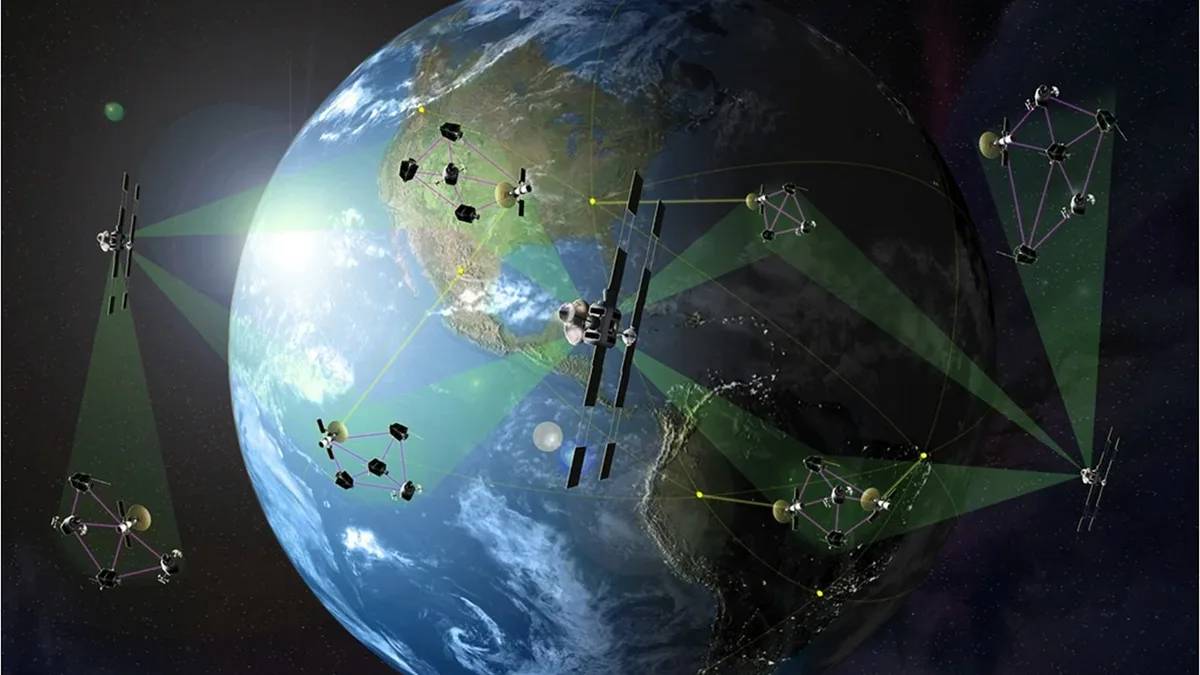
HawkEye 360 has demonstrated that its commercial radio-frequency sensing satellites can detect and characterize signals from other satellites. The test, conducted under a $1.2 million Air Force Research Laboratory (AFRL) Phase II Small Business Innovation Research (SBIR) contract awarded in 2024, successfully intercepted active transmissions from spacecraft operating in low Earth orbit (LEO), medium Earth orbit (MEO), and geostationary Earth orbit (GEO). The company released the results in a whitepaper outlining the work.
The demonstration adapted HawkEye 360's existing formation-flying satellite clusters. These clusters, originally engineered to detect and geolocate terrestrial emitters, were used to track space-based RF signals. The constellation uses onboard software-defined radios and directional algorithms. The contract validated the capability of LEO-based RF sensors to detect, identify, and characterize transmissions from space objects across multiple orbital regimes.
Technical advancements enable automated, reliable detection across orbital regimes
To achieve the milestone, HawkEye 360 developed new concepts of operations (CONOPS), processing techniques, and algorithms. For GEO and MEO satellites, the company modified its pointing techniques to validate RF-signal detection from target satellites operating overhead. For fast-moving LEO satellites, new CONOPS were developed to enable RF-detection despite high relative speed and short collection windows.
The company developed unique processing techniques to match RF detections to the correct satellites. These techniques reduced false positives. They enabled automated RF-detection missions against specified targets. HawkEye 360 fed the collected data into an automated-processing pipeline. This pipeline supports space domain awareness (SDA) missions with limited human-in-the-loop requirements.
Strategic implications for defense and commercial space awareness
The results suggest a path toward robust, commercially supplemented SDA capabilities for the U.S. Department of Defense (DoD) and NASA. The contract specifically tasked HawkEye 360 with determining if its RF-sensors could tell whether a satellite is transmitting, communicating with a specific ground station, or altering its usual behavior.
Space-based RF sensing provides strategic advantages over traditional ground-based tracking. Terrestrial radar and optical sensors face constraints from atmospheric attenuation, weather interference, solar blindness, and geographical limits. Repositioning RF sensors in orbit captures direct line-of-sight signal telemetry without blockages. The system delivers uninterrupted tracking of active satellite payloads and dynamic orbital maneuvers.
As low Earth orbit becomes increasingly congested, space domain awareness has shifted from simple orbital tracking to real-time spectrum monitoring. Space-based RF sensing allows military operators to detect electronic countermeasure attempts, track satellite cross-links, and verify the operational status of uncooperative assets. This successful demonstration provides the DoD and U.S. Space Force with a dynamic, commercially sourced layer for multi-domain awareness.
Incorporating orbital target tracking into HawkEye 360's existing ground-directed RF collection pipelines enables dual-use operational elasticity. It does not require dedicated SDA hardware architectures. The milestone completes work performed under AFRL's SBIR initiative, established to adapt high-maturity commercial satellite capabilities to address tactical defense requirements.
Leadership confirms operational maturity and future focus
Todd Probert, Chief Operating Officer of HawkEye 360, emphasized the demonstration's significance. "Some satellite emissions may be difficult or impossible to observe from the ground because of antenna directionality or atmospheric effects," Probert said. "A space-based RF sensor can access signals and geometries that a terrestrial sensor may not."
He stated that the work has moved beyond proving the concept. This is no longer simply a question of whether commercial space-based RF can contribute to SDA. We demonstrated that it can, Probert said. The work now is about continuing to mature the capability and identifying where it can provide the greatest operational value across defense, civil and commercial space missions.
Following the AFRL demonstration, HawkEye 360 plans to further integrate space-target processing algorithms across its operational satellite clusters.